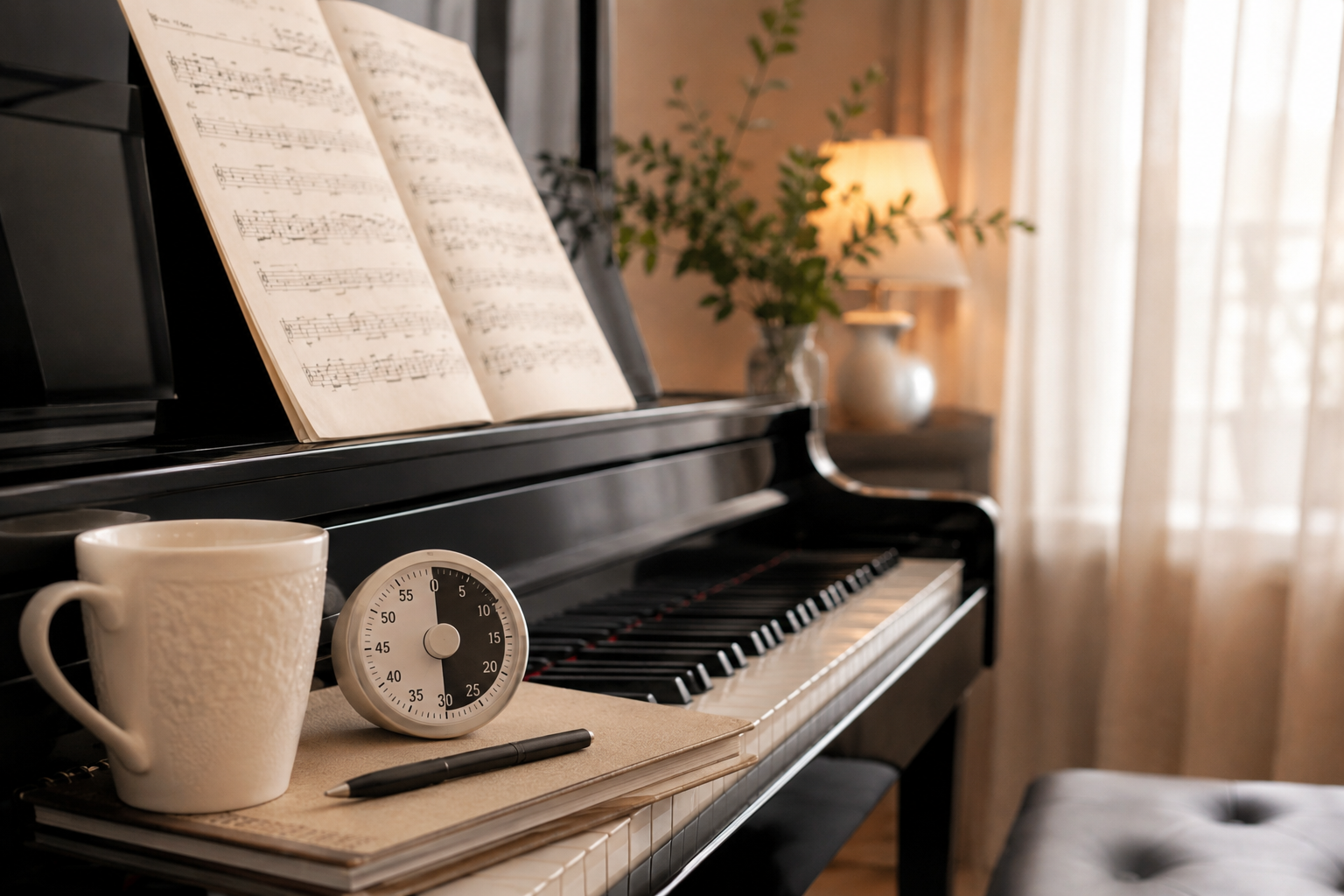
The Secret to 30 Minutes of Consistent Piano Practice
I recently met with my high school music theory teacher and asked her a question that never crossed my mind for years. I asked her why she decided to teach Music Theory instead of becoming a violin player. She simply said, because I had pain in my right hand that was stopping me from becoming a professional violinist. She also said something I already knew, in order to avoid injuries as a musician, one of the rules of thumb is to practice consistently, every day, even if this means 30 minutes a day. Of course, there’re other ways to avoid pain and injuries. But instead of practicing 4 hours one day and then taking a break for another 4 days, we need to remember to be consistent daily.
Imagine if an athlete works out only once per week and then returns to the practice facility a week later and starts lifting very heavy weights. Well, we know what will happen. The same applies to musicians, even though it’s not a heavy weight we lift, we use our hands and muscles, we engage our shoulders, and necks, too.
Why 30 Minutes Can Transform Your Piano Playing
Many piano beginners believe in the myth that progress requires hours of practice every day. In truth, consistent short sessions can be far more effective—especially for adult pianists balancing busy schedules.
30 focused minutes of daily piano practice can lead to steady improvement, better memory, and deeper enjoyment of playing. The secret lies not in how long you practice, but how intentionally you use your time.
The Problem with “More Is Better”
Many adult students sit at the piano for hours, but they have no clear goal of what they want to achieve. They might start with scales, jump from one piece to another, then wonder why nothing feels better than the day before.
This kind of unstructured practice often leads to burnout and plateaus. Instead of feeling motivated, players end up skipping days, and the inconsistency slows progress even more.
The solution? Create a 30-minute routine that’s structured, mentally engaging, and repeatable—something you can stick to every day, no matter how busy you are.
The Ideal 30-Minute Daily Piano Routine
Here’s a time-tested structure that helps adult pianists build skill efficiently:
1. Warm-Up and Technique (10 minutes)
Start by waking up your hands and focusing your mind.
- Scales and arpeggios: Choose one key per day to cycle through all 12 over time.
- Finger independence drills: Hanon or Czerny exercises in small sections work wonders.
- Slow coordination practice: Try hands-separate work at a slow tempo to align motion and relaxation.
Focus on even tone, relaxed hands, and steady rhythm. This phase sets up good habits before you even touch your repertoire.
2. Problem-Solving Practice (10 minutes)
This is the heart of your 30-minute session. Pick a specific section (4–8 bars) of a piece and work deeply on it.
- Isolate the problem: Maybe it’s a tricky rhythm, awkward jump, or voicing balance.
- Use micro-goals: Play the left hand alone, slow it down, or use rhythmic variation.
- Loop smartly: Don’t just repeat mindlessly. Each repetition should fix one small issue.
When you focus on one problem at a time, you’ll be amazed at how much better your piece sounds after only a week of consistent 30-minute sessions.
3. Musical Expression (10 minutes)
Now that your fingers are warm and your problem spots are improving, end with music making.
- Play something you love—perhaps a piece you can already perform comfortably.
- Experiment with phrasing, dynamics, and tone color.
- Record yourself occasionally to track progress and stay motivated.
This last phase reminds you why you love the piano in the first place and keeps your emotional connection to music alive.
Why This 30-Minute Routine Works
This approach succeeds because it uses focused attention instead of raw time. Here’s why it’s so effective:
- Consistency builds muscle memory.
Daily short sessions keep your neural connections fresh. Even 15–20 minutes a day is better than two long sessions per week. - Mental focus stays sharp.
Adults tend to lose concentration after 25–30 minutes. Keeping practice short ensures high-quality work. - Reduced frustration = long-term motivation.
Seeing small wins daily gives you a sense of accomplishment that fuels momentum. - Habit formation becomes natural.
A 3 0-minute task is easy to fit into your routine, making consistency effortless.
The Science Behind Short Practice Sessions
Neuroscience backs this up. Studies on skill learning show that spaced repetition—small, frequent sessions—is more effective than long, infrequent ones.
Your brain consolidates new skills during rest periods, meaning that the real learning happens between sessions. A daily 30-minute routine maximizes that process by keeping the piano fresh in your muscle memory.
Common Mistakes to Avoid
Even short practices can be ineffective if done poorly. Watch out for these common traps:
- Mindless repetition. Simply playing through a piece doesn’t equal progress.
- Ignoring slow practice. Speed comes from clarity—always slow down first.
- Skipping warm-ups. Even five minutes of technical focus prevents tension and injury.
- Practicing without goals. Always decide what you want to fix before you start.
- Comparing progress to others. Every pianist’s journey is unique—measure growth by your consistency, not speed.
How to Stay Motivated
Sticking to a new habit takes commitment. Try these ideas to stay inspired:
- Track your sessions. Use a notebook or app to mark daily practice streaks.
- Reward yourself. Celebrate each week of consistency with something small—a coffee, a new score, or simply replaying your improvement.
- Use visual cues. Keep your piano visible and inviting. Open sheet music or a “practice reminder” on top of the keyboard helps.
- Set musical milestones. Plan small “recitals” for friends or record yourself monthly to measure growth.
Remember, it’s not about perfection—it’s about showing up for 30 minutes a day.
The Compounding Power of 30 Minutes a Day
Think about it this way:
30 minutes a day × 7 days = 3 hours and 30 minutes per week.
In a month, that’s nearly 14 hours of focused, quality practice.
That’s 14 hours of building dexterity, memory, and confidence—without overwhelm or burnout. Over time, these small sessions accumulate into real artistry.
Conclusion
Consistency is the real secret behind every great pianist—not raw talent or endless hours.
When you commit to just 30 minutes a day, you train your mind and body to show up with purpose. You’ll feel progress in your fingers, clarity in your playing, and joy in every note.
So, the next time you think, “I don’t have time to practice,” remember—you only need 30 minutes that truly work.