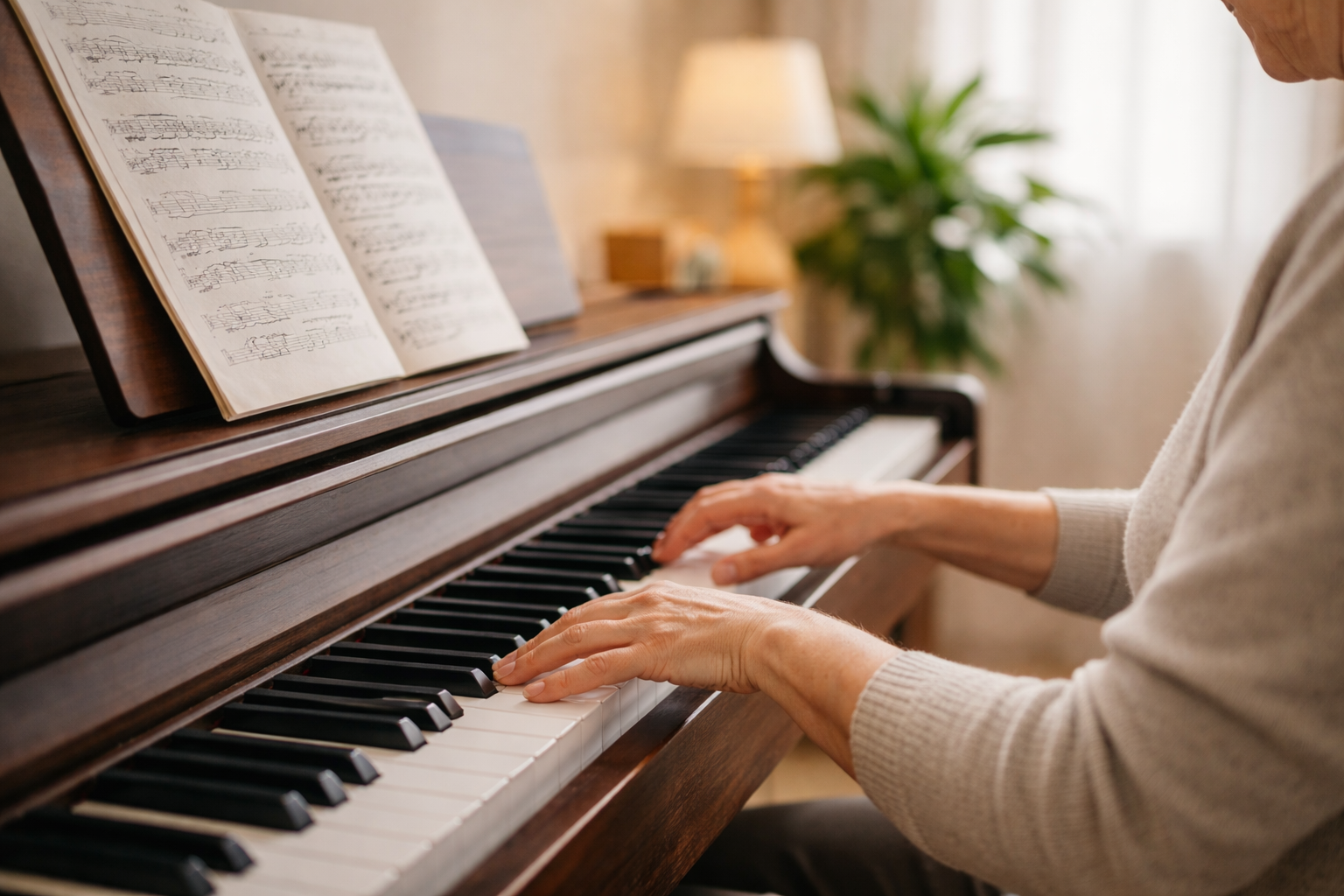
How To Balance Technique and Improve Musical Expression.
For many adult pianists, practice feels like a constant tug-of-war.
On one side, there’s technique: finger strength, scales, accuracy, speed, and control.
On the other, there’s musical expression: tone, phrasing, emotion, and connection.
When you get in your head your technique and playing feels stiff and mechanical.
When you focus too much on expression, playing feels insecure or unreliable.
The solution isn’t choosing one over the other—it’s mindful practice, where technique and musicality develop together.
Why Adult Pianists Struggle with This Balance
Adult learners often think as perfectionists: “If I can’t play this without making mistakes, why continue.” When you practice, you hear every mistake. You notice tension in your hands, without thinking that you could injure yourself, but you still keep going. You worry about “doing it right.”
As a result, many adults:
- Practice mechanically to avoid mistakes
- Delay musical expression until “later”
- Focus on notes instead of sound
- Judge themselves constantly while playing
Over time, this creates frustration. The fingers may improve, but the music feels lifeless—or the desire to practice fades altogether.
Mindful practice offers a different path.
What Focused Practice Really Means (At the Piano)
Mindful practice isn’t about emptying your mind. At the piano, it means:
- Practicing with full attention
- Focusing and paying attention to every sound quality, not just pitch
- Noticing tension in your hands or fingers, movement, and release
- Playing with intention, even at slow tempos
Instead of asking:
“Did I play the notes right?”
You begin asking:
“How did that feel? How did that sound? Were my wrists relaxed?”
This shift is powerful—especially for adult pianists.
One of the biggest mistakes adult pianists make is aiming at technique first and expression second.
The problem is that once you create a bad habit, you’ll have to unlearn it later on.
When you practice a passage:
- flat,
- loud,
- rushed,
- or without phrasing,
your hands memorize that version.
Mindful practice means:
- shaping dynamics from the start
- breathing with phrases
- listening for balance between hands
- playing slowly but musically
Expression isn’t decoration—it’s part of the technique.The Dangerous Myth: “I’ll Add Musicality Later”
Technique Exists to Serve Expression
Learning to play with good technique is not about control for its own sake. It’s there to help you:
- shape a phrase,
- voice a melody,
- create contrast,
- and communicate emotion.
Examples:
- Relaxed wrists allow singing legato
- Arm weight creates warm tone
- Finger independence allows melodic voicing
- Flexible fingers and wrists allows for speed and freedom
When technique serves sound, practice becomes meaningful instead of mechanical.
Mindful Technique Exercises That Build Musicality
Even technical work can be expressive when practiced mindfully.
Scales
- Shape each scale like a phrase
- Lift your fingers high then drop them on the key
- Play staccato when possible
- Crescendo going up, decrescendo going down
- Listen for even tone, not just even fingers
Arpeggios
- Focus on connection between notes
- Release tension at the top
- Aim for warmth, not force
- Stop at each root note, this will help you land on the correct key. Once you can do it well, continue playing the arpeggio without stopping anywhere.
Finger exercises
- Practice softly
- Notice where tension appears
- Pause often and reset
- Play staccato to gain more finger independence
When technique feels musical, you’re more likely to practice consistently—and enjoy it.
Listening: The Skill Most Pianists Forget to Practice
Many adult pianists hear notes but don’t truly listen to sound.
Mindful listening means paying attention to:
- tone color
- balance between hands
- clarity vs harshness
- beginnings and endings of notes
Try this:
- Play a single phrase and listen as if you were in the audience.
- Record 30 seconds of your practice.
- Close your eyes while playing slowly.
Your ears will guide your technique far better than force ever could.
Breath, Body Awareness, and Tension Release
Tension is one of the biggest barriers to expressive playing.
Mindful practice includes awareness of:
- shoulders
- wrists
- jaw
- breath
Simple strategies:
- Exhale before difficult passages
- Stretch your hands and fingers
- Give your hands a light massage
- Lift your wrists up when you feel tension and give your hands a quick break in between notes and measures
- Allow silence between repetitions
- Release completely after phrases
- Notice where tension creeps in—and stop
When the body feels safe, expression flows naturally.
Why Mindful Practice Works Especially Well for Adults
Adults learn best when practice is:
- focused,
- intentional,
- emotionally meaningful.
Mindful practice:
- reduces frustration
- prevents injury
- improves memory
- builds trust in your playing
It turns practice into a positive ritual instead of a chore.
A 30-Minute Lazer Focused Practice Routine
- 5 minutes – Centering, posture, breath, gentle warm-up
- 10 minutes – Technical exercise with musical shaping
- 10 minutes – One problem spot, slow and attentive
- 5 minutes – Expressive play-through or favorite piece
End by asking:
“What felt better today?”, “What needs more focus next time?”
Final Thought
- Technique and musical expression work together not against each other.
- When you practice mindfully, your music skills will improve, which will lead to more positive practice sessions.
- And when practice feels musical, progress feels inevitable, and you will feel more accomplished for your efforts.